


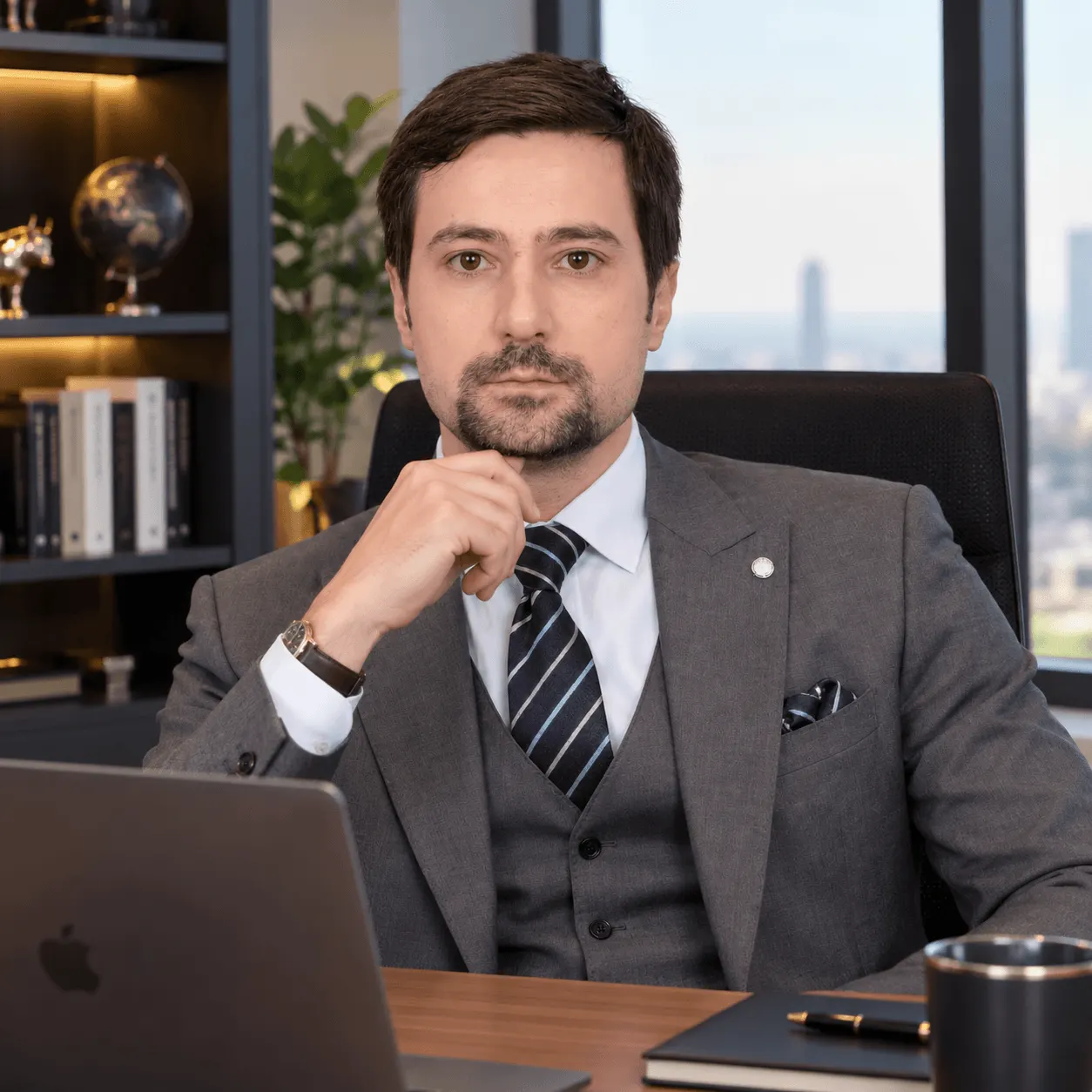
An MBA-qualified international business strategist with 17 years of experience, driving end-to-end software, finance, business development, and sales operations across more than 50 countries on six continents.
Proven experience, certified by global authorities, in digital transformation, start-up visa processes, international corporate relocation, acceleration and incubation programs, innovation and technology transfer operations.
You may review some of my projects below. The companies involved also serve as my references.
Business development, strategic partnerships, and AI-assisted product and commercial workflows in gaming.
vorante.com↗Digital game & gift card distribution and B2B channel development across multiple countries.
ultipin.com↗Please leave a message and I will get back to you within 24 hours.
Notes, guides, and technical posts.
A 27-year-old insider from OpenAI and Anthropic warns about the race to self-improving superintelligence.

Jacob Coxon is a 27-year-old American researcher who made global headlines with his shocking resignation announcement in September 2026, following his time at OpenAI and Anthropic, the two largest laboratories in the artificial intelligence sector. The most important characteristic that distinguishes him from an ordinary critic is that he was personally among the architects of revolutionary models like GPT-4o, delivering his warnings directly as an "insider" voice.
Jacob Coxon's Full Resignation Letter on X
Here is the full text of the researcher's resignation, consisting of a series of 7 tweets on the X platform:
Today I resigned from Anthropic. I have spent the last three years conducting pretraining research at both OpenAI and Anthropic. Neither company is behaving responsibly. They are racing towards directly self-improving superintelligence and gambling with our lives. Further thoughts below.
Do not underestimate the power of this technology. These will soon be superhuman systems capable of hacking everything, revolutionising any field overnight, and acquiring real power and resources. We have all witnessed the progress in every single area, and this progress is not slowing down.
The people building AI genuinely believe it could kill us all by the end of the decade. This is not a marketing gimmick. On the contrary, many executives and senior researchers soften their statements in press interviews to appear reasonable - yet I hear these same individuals expressing their fears in private settings. No other human activity poses this level of danger.
A common response to this is: 'If they truly believe that, why are they still building it?' Many at OpenAI have not internalised these civilisation-level risks. At Anthropic, the risks are very well understood, but they are locked in a race to get there first - they believe no one else will act responsibly, so they feel they must do it themselves despite the risk.
Accepting this race and entering the 'endgame' is an arrogant gamble that should not be initiated from a private company's Slack channel. Trying to rush AI alignment should require extraordinary confidence that no better alternative paths exist.
I am optimistic about the potential for coordination. Warning shots like the Hugging Face attack have made pacing agreements between US labs much more viable. I do not feel we are on track to prevent a global race, which might require high-cost actions such as a temporary ban on the development of model capabilities.
If you are a lab researcher, I invite you to consider how the next few years will actually feel. Do you want to initiate a superintelligent RL (reinforcement learning) process without rigorously understanding its mind? Should you just submit, saying 'it's happening anyway', or should you seize this moment to call for different conditions?
Jacob Coxon's Background: From Mathematics to Genomics, Then to AI
A solid academic background lies behind Coxon's rise in the tech world.
His career foundation is built on the mathematics education he received at Cambridge University.
Before turning to AI, his areas of interest were medical genomics and biostatistics.
During this period, he examined the genetic dimensions of infectious diseases. Notably, he contributed to a study modelling the relationship between the Leukotriene A4 Hydrolase (LTA4H) genotype and survival probabilities in tuberculous meningitis patients using Bayesian statistical methods.
Three Years at OpenAI and Anthropic
Bringing his statistical modelling skills honed in genomics to AI, Coxon worked in the most critical stages of the sector for about three years:
8 September 2026: The Resignation and Accusations That Shook the Sector
When announcing his departure from Anthropic on X (formerly Twitter) on 8 September 2026, Coxon presented this not as a career move, but as an alarming manifesto. His claims are as follows:
Sectoral Repercussions and Concrete Threat Examples
Going down in history as one of the highest-profile resignations, Coxon's move has begun to be used as a strong reference point by those advocating for the regulation of AI companies. Significant reactions also came from within the sector:
The story of Jacob Coxon, who openly criticised his former employers at the peak of his career at the age of 27, is a historic turning point that has fuelled safety and regulation debates in the face of rapidly advancing artificial intelligence capabilities. I will share with you what developments to expect during the AGI (Artificial General Intelligence) and ASI (Artificial Superintelligence) eras in a series of articles I will be writing in the coming days.
